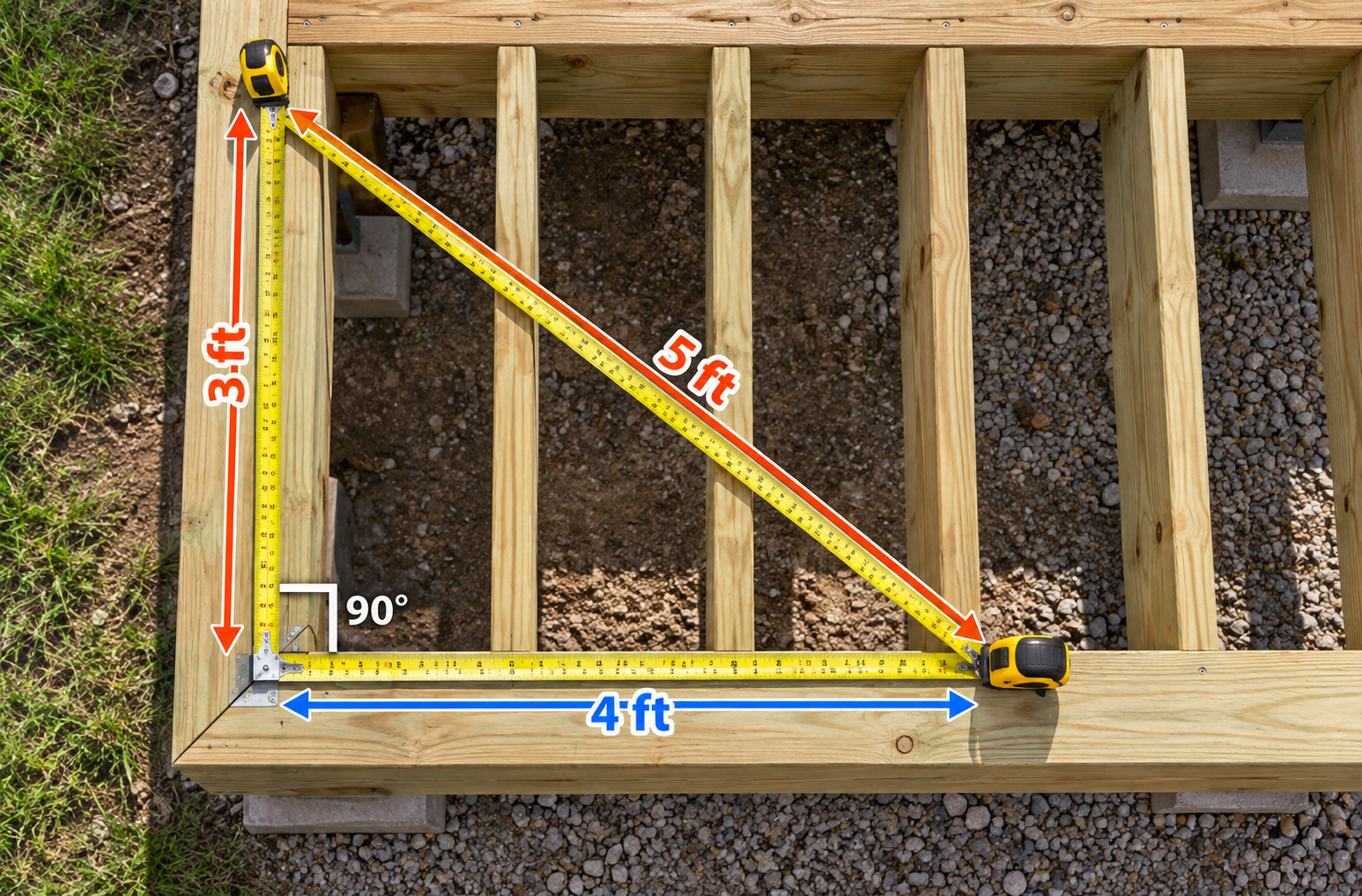
1. The 3/4/5 rule, along with the Pythagorean Theorem, is used to verify right angles.
A right-angled triangle always satisfies a² + b² = c². Plugging in 3 and 4 gives 9 + 16 = 25, which is 5², confirming the angle is exactly 90°. Measuring 3 feet in one direction and 4 feet in the other makes any error in the angle immediately visible when you check the diagonal.
Checking and eliminating measurement errors:
If you are measuring with one or more slight over- or under-measurements using a small speed square, you may discover the difference at each angle upon finding that the results across each corner differ.
Long beams that are erected without perfect measurements can sag over distance if the incorrect measurements were initially used, resulting in uneven structures, since a tiny speed square might not reveal a slight over- or under-measurement.
Scaling up: Increase measurements when determining the overall size of a larger structure, where 3, 4, and 5 feet are too close together to catch small errors. Use 6/8/10 or 9/12/15-foot increments instead.
2. Required Materials for the 3/4/5 Rule
The basic materials you'll need for utilizing the 3/4/5 rule are the framing pieces you're planning to use, along with:
- Tape Measure:
Required to make all measurements accurately.
- String Line and Batter Boards:
Also required to perform accurate framing layout measurements before finalizing construction. They can also be leveled, adjusted, or removed without leaving permanent markers or attachments on a surface.
- Speed Square or Carpenter's Square: Useful for a quick initial check, though not precise enough on its own to catch small errors over long spans.
3. First Reference
Use the 3/4/5 rule during the first stage of deck framing to determine if your framework is aligned before you've committed too much expense or time to your addition.
A specific starting point, or the location from which you begin measuring, depends entirely on the deck blueprint you've planned. Most builders use the house wall as the starting reference point. Mount the ledger board as close to the wall as possible, keeping it parallel to the house. This becomes your 3-foot reference line (Line A).
Side Rim Joist: Run one rim joist from your house-side ledger corner and build it out at a right angle, marking it Line B (4-foot-long measurement).
4. Adjusting the Diagonal Measurement
Measure the distance between the two measurement points. After marking both lines, measure diagonally across the endpoints of Line A and Line B, then adjust your framework by shifting the outside piece into place until the tape measures exactly 5 feet. This confirms a perfectly square frame at 90 degrees.
5. Why Professional Builders Still Matter
Though building using the 3/4/5 rule may appear relatively simple, ensuring that your entire frame is level, straight, and up to code takes significant education, training, and skill.
- Multi-levels and complex frames: Deck contractors may additionally use laser measures alongside methods like the 3/4/5 rule, or transfer marks for precise alignment required on multi-level or non-rectangular deck frames.
- Correct alignment of footings and joists: A seasoned deck builder can accurately lay out and determine the placement of each footing in relation to the framed structure, helping to prevent deck collapse.
- Codes and material management: Experienced deck builders adhere to local building codes and can make accurate, practical estimates of material quantity and usage, keeping your project efficient and within budget.
Conclusion
The 3/4/5 rule is a convenient construction trick worth using if you intend to square off your deck frame prior to attaching joists, posts, or any other lumber. By taking an additional 3-, 4-, and 5-foot measurement, you can establish perfectly square frame corners before proceeding with further construction. Simply scale up the distances, like 6/8/10 or 9/12/15, to properly test longer runs of lumber.
FAQs
What does the 3/4/5 rule do in deck building?
It verifies that two intersecting framing boards form a perfect 90-degree right angle to keep the deck frame completely square.
Can I use multiples of 3/4/5 for larger decks?
Yes. You can scale the ratio up to 6/8/10 feet or 9/12/15 feet, which provides even greater accuracy over long deck spans.
What happens if the diagonal measurement is more than 5 feet?
If the diagonal measurement is greater than 5 feet, your corner angle is wider than 90 degrees (obtuse).
When should I apply the 3/4/5 rule during construction?
Apply it at the very beginning of the project when setting up string lines and placing footing locations.
Is the 3/4/5 rule better than using a framing square?
Yes. Framing squares are only 16 to 24 inches long, making small errors harder to notice, whereas the 3/4/5 rule projects accuracy across several feet.